
Biography
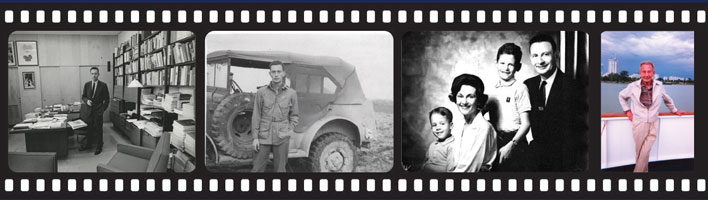
Born in Budapest, Hungary, on August 8, 1919, George Gerbner took an early interest in folklore and excelled as a poet. He enrolled at the University of Budapest in 1938 after winning first prize in Hungarian literature in a national competition of high school students.
Early Life & Path to America
In 1939 Gerbner fled to Paris to avoid conscription into the Hungarian army, then under a right-wing government allied with Nazi Germany. Unable to obtain a visa to enter the United States — where his half-brother Laslo Benedek was a Hollywood filmmaker — he traveled first to Mexico, then Cuba. A sympathetic consulate officer finally permitted him to sail from Havana to New Orleans, where he was received by his half-brother’s friends and met author Sinclair Lewis.
From New Orleans, Gerbner hitchhiked to California and enrolled at UCLA, though soon transferred to UC Berkeley to study journalism. Upon graduating he worked as a reporter and editor for the San Francisco Chronicle.
Military Service
A loosening of enlistment regulations in 1942 permitted Gerbner to join the U.S. Army — officially recognized as an “enemy alien” due to Hungary’s declaration of war on the United States. Trained as a paratrooper at Fort Benning, Georgia, he transferred to the Office of Strategic Services and arrived in Italy, joining its Secret Intelligence group.
In January 1945 he parachuted with two others into occupied territory along the Austrian-Slovenian border, operating behind enemy lines with resistance forces until the end of the war in Europe. After Germany’s defeat, Gerbner was sent to Austria to investigate a mass encampment of Hungarian soldiers, among whom was Hungary’s pro-Nazi prime minister Domé Sztójay. Gerbner helped arrest Sztójay and return him to Budapest, where he was tried and executed as a war criminal.
While stationed in Budapest, Gerbner met Ilona Kutas, an actress, whom he married in 1946.
Academic Beginnings
Returning to Los Angeles, Gerbner volunteered as a newspaper editor for the Independent Progressive Party while seeking employment. His leftist activism during Senator Joseph McCarthy’s anti-Communist crusade attracted the interest of the California House Un-American Committee, before which he was called to testify. Shortly after, he was hired to teach journalism at John Muir College (now Pasadena City College).
To earn teaching credentials, he began graduate coursework at the University of Southern California’s School of Education, completing a master’s degree in June 1951 with a thesis titled “Television and Education” and a Ph.D. in June 1955 with a dissertation titled “Toward a General Theory of Communication.”
“I came to the conclusion that communication is really where the action is — the political action, the social action, the cultural action.”— George Gerbner, interview with John Lent, 1992
University of Illinois 1956 – 1964
In 1956 Gerbner joined the faculty of the Institute of Communication Research at the University of Illinois, Urbana-Champaign, recruited by Dallas Smythe, who had met Gerbner as a visiting professor in USC’s Department of Cinema. He remained at Illinois for the next eight years.
Dean of Annenberg, University of Pennsylvania 1964 – 1989
In 1964 Gerbner left Illinois for the University of Pennsylvania, hired as Dean of the Annenberg School of Communication — only five years after the School was founded. He built a world-class research and teaching faculty, transforming it into a national leader in communication research and elevating the then-fledgling discipline into serious scholarly standing.
Under his tenure the School published the leading journal in the field, the Journal of Communication (which he served as editor and executive editor), created the first world encyclopedia of communications, and established The Washington Program, bringing communication researchers and practitioners together in Washington, D.C.
Former President Sheldon Hackney and former Provost Michael Aiken honored Dr. Gerbner by establishing the annual George Gerbner Lecture in Communications in 1988. He retired from the deanship in 1989 after 25 years — the University’s longest-serving dean — but continued to teach and research, founding the Cultural Environment Movement (CEM) in 1991 before retiring from Penn in 1994.
Cultural Indicators Project
Dr. Gerbner founded and headed the Cultural Indicators Project, his most celebrated contribution to the field, designed to track changes in television programming and examine how television shapes Americans’ perceptions of society. The project’s database ultimately encompassed over 3,000 television programs and 35,000 characters.
Honors & Recognition
- Named ICA Fellow by the International Communication Association, 1979
- Appointed chair of the Subcommission on Communications and Society, Commission on the Social Sciences of the American Council of Learned Societies (ACLS), 1986
- Honored with the establishment of the annual George Gerbner Lecture in Communications at Penn, 1988
Later Years
In 1997 Dr. Gerbner joined Temple University as the Bell Atlantic Professor of Telecommunications, where he continued to teach, conduct research, and advocate through the Cultural Environment Movement.